How to Calculate EMI for a Home, Car or Personal Loan
Learn how EMI is calculated, see worked examples for home loans, and use a free EMI calculator to compare tenures, total interest and your monthly budget.
By FreeToolsHub Editorial TeamPublished5 min read
Before you take a loan, the most useful question is not "What is the rate?" but "What will it cost me in total, and can I afford the monthly payment?" The EMI Calculator answers both in seconds. This guide explains what EMI means, how it is calculated, and how to use the tool to compare loan options sensibly.
What is an EMI?
EMI stands for equated monthly instalment. It is the fixed amount you pay every month to repay a loan. Each EMI covers two things: the interest for that month and a part of the original loan, called the principal. The amount stays the same every month, but the split between interest and principal changes.
Calculate your EMI in four steps
- Open the EMI Calculator.
- Enter the loan amount. Commas are fine, for example 25,00,000.
- Enter the yearly interest rate your bank quotes, such as 8.5.
- Enter the tenure and choose years or months.
You see the monthly EMI, the total interest, the total you will repay and a repayment schedule. Tick Show every month to see how each instalment is split between principal and interest.
The formula behind the number
For a reducing-balance loan, which is how most home, car and personal loans work, the EMI is:
EMI = P × r × (1 + r)^n ÷ ((1 + r)^n − 1)
- P is the loan amount.
- r is the monthly interest rate: the yearly rate divided by 12, and by 100 to turn the percentage into a decimal.
- n is the number of monthly instalments.
You do not need to work this out by hand, but it shows why the numbers behave as they do: a higher rate or a longer tenure both change the result in ways that are not obvious at first.
Worked examples
These figures come from the calculator itself, so you can reproduce them.
| Loan | Rate | Tenure | Monthly EMI | Total interest | Total repaid |
|---|---|---|---|---|---|
| 10,00,000 | 10% | 10 years | about 13,215 | about 5,85,809 | about 15,85,809 |
| 10,00,000 | 10% | 15 years | about 10,746 | about 9,34,289 | about 19,34,289 |
| 10,00,000 | 10% | 20 years | about 9,650 | about 13,16,052 | about 23,16,052 |
| 25,00,000 | 8.5% | 15 years | about 24,618 | about 19,31,328 | about 44,31,328 |
| 25,00,000 | 8.5% | 20 years | about 21,696 | about 27,06,939 | about 52,06,939 |
Look at the first three rows. The loan and the rate are the same. Stretching the tenure from 10 to 20 years lowers the EMI from about 13,215 to about 9,650 rupees a month, but the total interest more than doubles, from about 5.9 lakh to about 13.2 lakh rupees. That is the trade-off in one table.
Why early EMIs are mostly interest
Interest is charged each month on the balance you still owe. At the start the balance is large, so most of your EMI pays interest and only a small part reduces the loan. As the balance falls, the interest part shrinks and more of each EMI goes to principal. The year-by-year schedule in the calculator shows this clearly. It is also why paying a lump sum early in the loan saves more interest than the same payment made near the end.
How to choose a tenure
A longer tenure gives a smaller EMI but a much larger interest bill. A shorter tenure gives the opposite. A sensible way to decide:
- Try three tenures for the same loan, for example 10, 15 and 20 years.
- Note the EMI and the total interest for each.
- Choose the shortest tenure whose EMI you can pay comfortably every month, including in a month when your income is lower.
- Leave room in your budget for other costs, such as insurance, maintenance and emergencies.
What the calculator does not include
The calculator assumes one fixed rate for the whole loan. Real loans can differ in these ways:
- Floating rates change over time. If your rate changes, recalculate from the balance and the new rate.
- Processing fees, insurance and other charges are not included.
- Part-prepayments reduce your balance and interest, but are not modelled here.
- Rounding may differ slightly from your bank's statement.
Use the result for planning and comparison, and rely on your loan agreement for the exact figures. This is a calculator, not financial advice.
Related tools
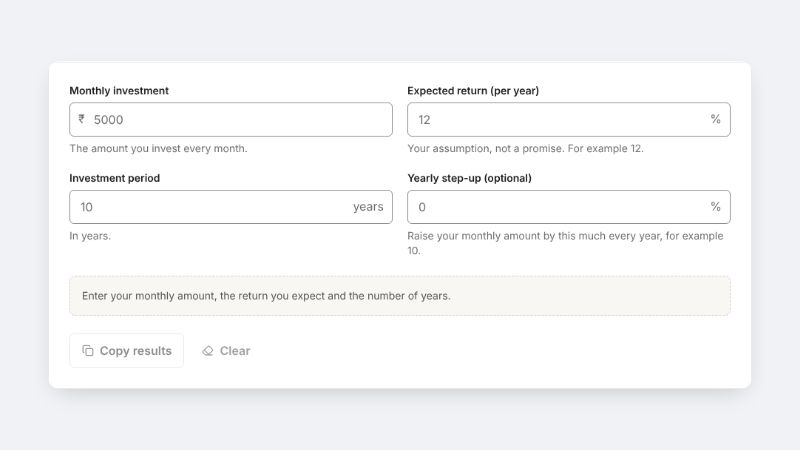
Planning ahead also means thinking about saving. The SIP Calculator shows what a monthly investment could grow to. To compare two numbers as a percentage, use the Percentage Calculator. If you run a business, see how GST is calculated in India.
Frequently asked questions
What is an EMI? The fixed monthly amount you pay to repay a loan, covering interest and part of the principal.
Is the total interest exact? It is the exact result of the standard formula for the numbers you enter. Banks may round monthly or add fees, so your real figures can differ slightly.
Does it work for floating-rate loans? It assumes a single fixed rate. If your rate changes, recalculate from the new balance and rate.
Can I enter a 0% loan? Yes. The EMI is then the amount divided by the number of months.
Try your own numbers in the EMI Calculator and compare two or three tenures before you decide.